One unexpected step can undo an otherwise perfect seafront afternoon. That is the thought I keep in my head whenever I plan a Cyprus trip around a wheelchair, and it shapes everything below. I don’t treat accessibility as a feature a hotel either has or hasn’t got. I treat it as a chain of small links (airport, transfer, room, bathroom, beach, restaurant) and the trip is only as good as the weakest one.
Cyprus can work very well for wheelchair users, especially on the coast, but the island rewards people who ask awkward questions before paying. This guide is built the way I plan: five questions first, then the practical detail for each stage of the journey, then a way of pulling it together into days that don’t leave you stuck at the bottom of a flight of steps.
The five questions I ask before I book anything
- What is the exact door width, and is it the clear opening? A published width for a door frame is not the same as the usable gap once the door is open.
- Is the shower level-entry, and where does the transfer happen? “Walk-in” and “wet room” are marketing words, not measurements.
- What is the approach like? A step-free entrance at the top of a steep driveway can still be hard work without help.
- Who is doing the transfer, in what vehicle? An ordinary taxi, even a roomy one, may mean transferring into a seat.
- Can I get this in writing? If a property or driver won’t confirm in an email, I treat the answer as a no.
Everything else in this article is really just those five questions applied to a different part of the trip.
Key points before you read on
- Both Larnaca and Paphos airports provide reduced-mobility facilities, but assistance has to be requested in advance.
- Accessible beach equipment varies by location and season, so check it for your dates.
- Hotel accessibility labels don’t confirm bathroom layouts, door widths or transfer space.
- Historic sites and mountain villages need individual checks, because access often covers only part of the attraction.
Choosing a base: where I’d start looking
Larnaca and Paphos for coastal holidays
For a short break I lean towards Larnaca, mainly because the airport is so close to town. Shorter transfers mean fewer transfers, and for a wheelchair user every transfer is a point where something can go wrong. Finikoudes brings the seafront, restaurants and beach into one stretch, so you aren’t forever arranging vehicles to get between them.
My Larnaca travel guide compares the neighbourhoods. Whichever you pick, check the actual route from the hotel to the promenade: dropped kerbs, crossings and the state of the pavement matter far more than the distance on a map.
Paphos suits a holiday that mixes harbour dining with archaeology. The catch is that “Paphos” on a booking site covers a wide area. Pick a base near the sights you actually plan to visit rather than assuming every property sits beside the waterfront, and remember that the walk up towards the old town is a gradient, not a stroll. If you are still choosing between the two resorts, Paphos versus Limassol is a useful comparison.
Limassol, Protaras and quieter coastal areas
Limassol offers seafront outings, restaurants and city facilities. Protaras and Ayia Napa are popular beach-focused stays, although resort hotels often sit further from the shops than the photographs suggest, which matters if you want to be independent for evening meals.
Polis and Latchi make a quieter western alternative. There I’d research nearby meal options and the general infrastructure as carefully as the beach itself, because a lovely cove with no accessible lunch stop makes for a long day.
Airports and getting around
Arranging assistance at Larnaca or Paphos
Both international airports list accessible toilets, electric-wheelchair charging points at departure gates and assistance for passengers with reduced mobility. Those facilities are real and useful, but they don’t make every stage of the journey automatically step-free, so I don’t plan as though they do. If you are undecided which airport to use, I’ve compared them in Larnaca vs Paphos airport.
Hermes Airports advises requesting assistance through your airline, travel agent or tour operator at least 48 hours before departure, and arriving at least two hours before your flight, subject to your airline’s own instructions. I’d do both, and put the request in writing so there is a record.
Give the airline your wheelchair’s dimensions, weight and battery details. I’d also attach clear handling instructions and photograph the chair before handing it over. Then confirm where you will be reunited with it after landing, because that is the question people forget until they are standing in an arrivals hall without it.
Book the right vehicle, not simply a taxi
Accessible taxis and buses with ramps can be arranged with advance notice. An ordinary airport taxi, or a vehicle merely described as “spacious”, may require you to transfer into a seat, which defeats the purpose.
The specialist Accessible Cyprus Travel listing gives a contact for discussing mobility equipment and arrangements; confirm current services directly rather than relying on a listing.
Before booking, I’d send the wheelchair’s dimensions and the combined occupied weight, then ask about ramp or lift capacity, headroom and wheelchair restraints. Agree the full euro fare, waiting charges, luggage allowance and what happens if the flight is delayed. Save the driver’s contact details offline.
For public transport, ask the operator about your exact bus service, boarding stop and return journey. A low-floor vehicle elsewhere in the fleet doesn’t confirm access on your departure. Late arrivals and rural accommodation make pre-booked transfers especially worthwhile.
Accommodation: check the exact room, not the hotel
Published details worth knowing about
Golden Bay Beach Hotel in Larnaca publishes details of a disabled-friendly room with a roll-in shower, grab rail and shower chair. Its stated bedroom-door width is 77 cm, while the bathroom door is 95 cm. If you use a wider powered chair, a 77 cm figure is exactly the kind of number to question: ask whether it describes the usable clear opening rather than the frame.
Aphrodite Hills Resort publishes information about six adapted rooms, including door and lift measurements. That is more than most properties offer, but it still doesn’t confirm a roll-in shower or enough transfer space for you.
I treat specifications published by accessible hotels as a starting point, never a conclusion. DisabledHolidays.com’s Cyprus accommodation listings are useful for building a shortlist, but I’d still want written confirmation that each property meets my requirements.
Bathroom layout and daily access
Ask for recent photographs of the actual room category you are booking. Check bed height, the space beside the bed, which side the toilet transfer is on and how the shower is entered.
“Walk-in shower” doesn’t necessarily mean level entry, and a wet room may still lack the grab rails or seat you need. If you require a hoist, confirm availability, compatibility and delivery before booking. Also ask about lift dimensions, restaurant access and the route to the pool, and get all of it in writing.
The email I send is short and boring on purpose:
Hello, I use a wheelchair (width and weight below). Please confirm in writing the clear width of the bedroom and bathroom doors, whether the shower is level-entry, the toilet transfer side, and whether there is step-free access from the entrance to the lift, restaurant and pool. Photographs of the exact room would be very helpful.
If the reply is vague, that tells me something too. For a stay in the capital, my Nicosia old city walking guide explains the layout and what the narrow streets mean for a chair, though it can’t replace a room-specific accessibility check.
Beaches and sea access
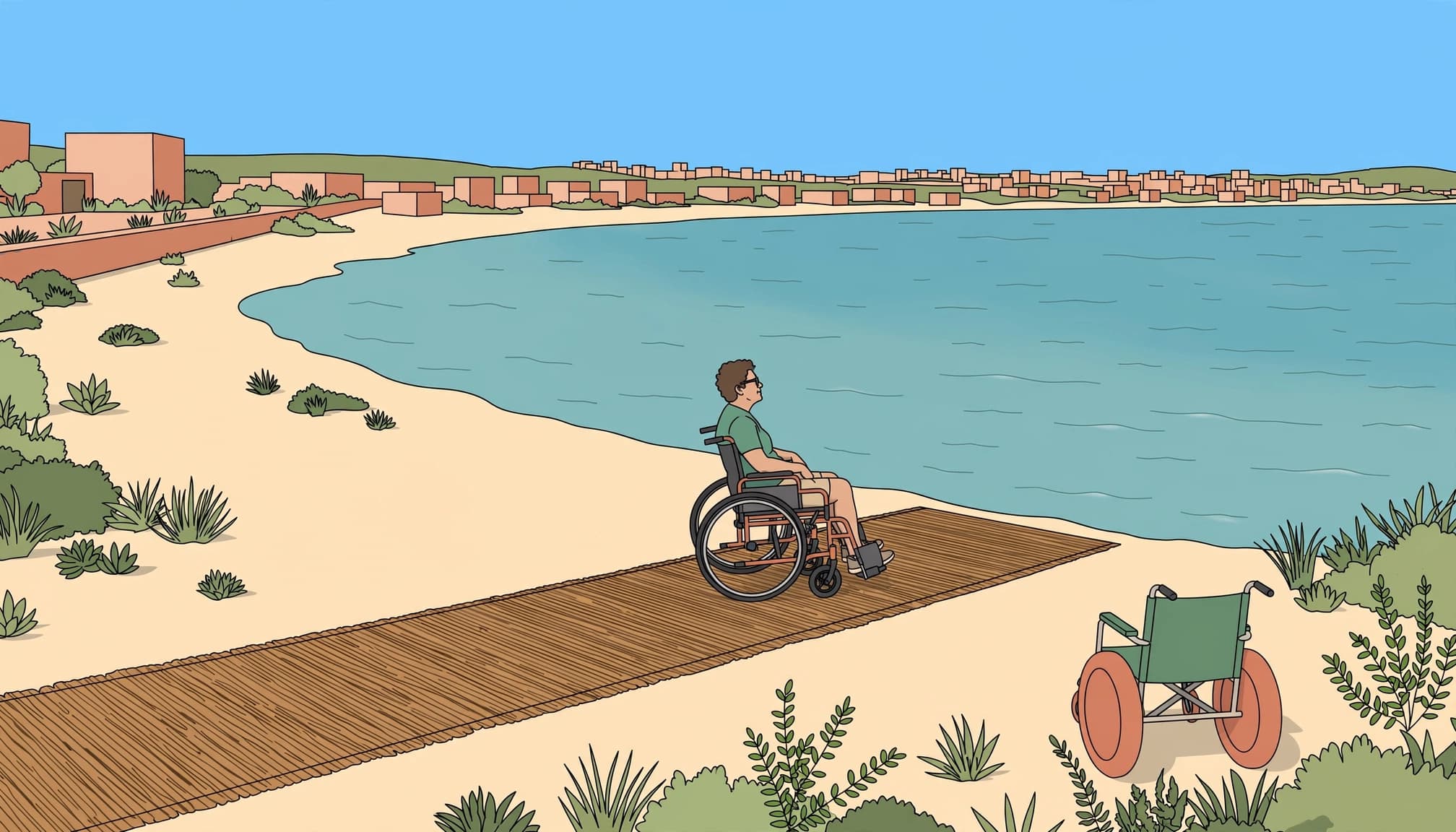
Cyprus has beaches with ramps, accessible toilets and beach wheelchairs. Reaching the beachfront, though, is a different thing from getting into the water, and I plan the two separately.
What the official list records for Paphos, Polis and Latchi
The Deputy Ministry of Tourism’s 2025 list records 56 accessible beaches: 44 with full access and 12 with partial access. These are dated classifications, not a promise that the equipment is running throughout 2026, which is why I use the list to shortlist and then phone to confirm.
| Beach | Listed equipment, including beach wheelchairs |
|---|---|
| Vrysoudia A’, also called Sodap, Paphos | Floating wheelchair |
| Polis Municipal Beach | Seatrac and floating wheelchair |
| Latchi A’, B’ and Xistarokampos | Floating wheelchairs |
| Latchi C’ | Seatrac and floating wheelchair |
If beach wheelchairs are a priority, Polis and Latchi stand out on that list. My Polis travel guide covers the surrounding area.
Check the equipment before you set off
The European Commission’s accessible beaches information points towards the official listings. Check the individual beach rather than trusting a resort-wide claim.
Ask whether beach wheelchairs are operational, whether someone is on hand to help and how transfers work. Seatrac is a powered sea-access system, while a floating wheelchair involves a different transfer, and which suits you depends on your own mobility.
A ramp to the sand doesn’t confirm that you can enter the sea or use the equipment independently.
For Fig Tree Bay or Nissi Beach, verify the current facilities directly, and check lifeguard hours and accessible toilet opening times, particularly outside summer.
Sights and historic sites
Promenades make for straightforward coastal outings; archaeological sites take more preparation. My rule is one main outing per day with an accessible lunch stop nearby, so that a closed gate or a blocked path doesn’t wreck the whole itinerary.
Paphos Archaeological Park
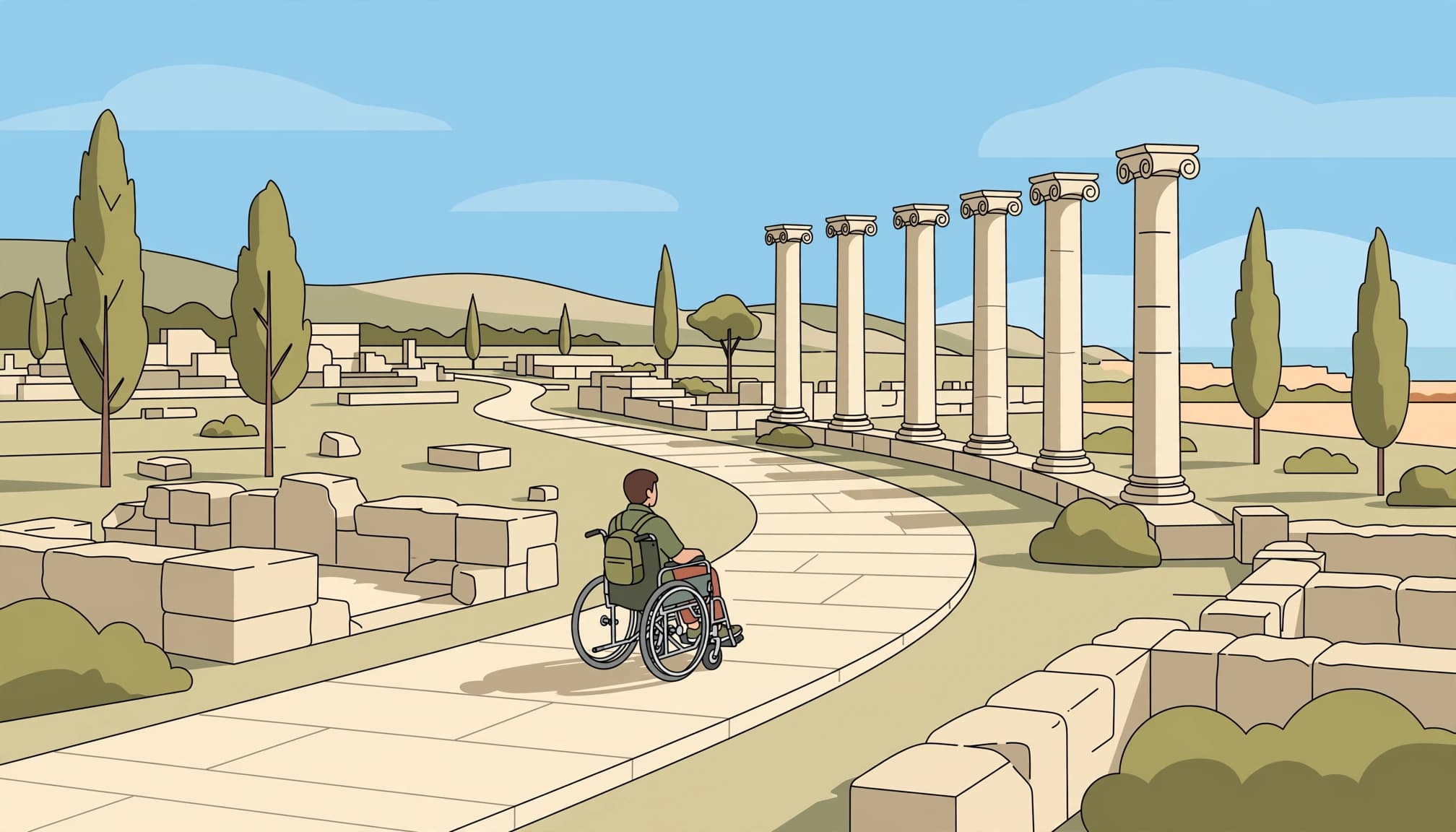
Kato Pafos Archaeological Park contains Roman villas and celebrated mosaics, but official visitor information describes it as only partly accessible. An older tourism brochure records accessible parking and toilets while saying the wheelchair route is unmarked.
So I wouldn’t arrive and improvise. Ask staff which entrance, paths and mosaic areas suit your chair, and don’t assume the paving is smooth throughout. Allow extra time, carry water and go early when it is cooler. If one section is out of reach, ask what you can reach without retracing a difficult route.
Nicosia and Larnaca Salt Lake
The Cyprus Museum is a worthwhile cultural stop in Nicosia. Request current entrance, lift and toilet information first, as the guidance I found doesn’t confirm a complete wheelchair route.
Around Larnaca Salt Lake, I separate the viewpoint or monument visit from the nature trail. Hala Sultan Tekke has partial access, while the lakeside trail includes uneven, unpaved stretches. My Salt Lake and Hala Sultan Tekke guide explains the distinction. I’d agree a drop-off and collection point with the driver instead of committing to a continuous lakeside circuit.
Parking, mountain villages and practical preparation
European parking cards and UK Blue Badges
Cyprus recognises the European disability parking card. EU guidance allows valid card holders free, unlimited-time parking on roads where parking fees normally apply, but not where parking is prohibited. Public car parks may set their own conditions, so read the signs or ask an attendant before leaving the vehicle.
If you are travelling with a UK Blue Badge, check whether it is currently recognised in Cyprus and confirm local requirements before relying on it. Our own entry requirements guide covers the paperwork side of the trip. I wouldn’t build an itinerary around assumed free parking or a guaranteed space beside every attraction, and I’d always confirm the nearest suitable drop-off too.
Rural outings built around confirmed stops
Troodos villages offer tavernas, monasteries and mountain scenery, but steep lanes and stepped entrances can limit access. My Kalopanayiotis village guide highlights how challenging the gradients can be.
Before arranging a rural outing I want one accessible restaurant and one suitable viewpoint confirmed. Ask for photographs of entrances and toilets, then agree where the vehicle will park and when it will collect you.
Cyprus drives on the left, which helps UK drivers, but an ordinary hire car won’t suit everyone with mobility impairments. Confirm transfer arrangements, wheelchair storage or adapted controls before reserving.
How I’d shape a day
Rather than a fixed itinerary, I use a pattern that survives surprises:
- Morning: the one demanding thing, such as an archaeological site, while it is cooler and you are fresh.
- Midday: lunch somewhere I have already confirmed is step-free, with a proper accessible toilet nearby.
- Afternoon: something flat and flexible, such as the seafront, which can be cut short without losing anything.
- Evening: a short, known route back, with the transfer booked rather than hoped for.
Heat is worth planning for too. Summer afternoons on exposed paving are tiring for anyone, and a powered chair’s battery range can be affected by long days and hills, so I’d always keep a margin and know where I can charge. Arrange travel insurance that covers your medical needs and mobility equipment, and keep supplier confirmations, medication details and transport contacts available offline. If something does go wrong, 112 is the emergency number across Cyprus and the EU.
Frequently asked questions
Can wheelchair users holiday in Cyprus without hiring a car?
Yes, if you choose a suitable central hotel and confirm local routes. I’d budget for pre-booked accessible transfers rather than assuming every bus or taxi can take your chair.
Will a UK wheelchair charger work in Cyprus?
Cyprus uses UK-style Type G sockets, so the plug should fit; see my plugs and adaptors guide. Still check your charger’s voltage requirements and ask where you can charge safely at the hotel. Carry the original charger plus any manufacturer-approved accessories you need.
Do these arrangements also cover Northern Cyprus?
Don’t assume they do. Crossings involve separate transport and insurance considerations, which I cover in the Nicosia buffer zone crossing guide. Ask your transfer provider whether cross-border journeys are available, and check accommodation and attraction access independently on the northern side.
The short version
The best accessible Cyprus plans I know start with confirmed everyday access: the room, the transport and the routes you’ll use most. Beach equipment and heritage sites then add choice rather than risk.
Get the details in writing before you pay, keep each day to one main outing, and leave room for the unexpected. Do that and the sea, the mosaics and the long Cypriot lunches are all within reach.