Yes, Cyprus uses the same plugs as the UK. Sockets are Type G at 230 V, so our normal UK charger plugs straight into the wall, which makes packing simpler than for most European holidays.
For UK holidaymakers, Cyprus plugs are Type G, the familiar three-pin format used at home. We won’t need a travel adaptor for a British plug, so there is one less item to buy before flying.
Still, a device bought abroad, a high-wattage appliance, or a room with few sockets can cause problems. We check the label before packing, then take a modest charging setup rather than a bag of adaptors.
Cyprus Plugs: Do UK Visitors Need an Adaptor?
UK visitors do not need an adaptor for ordinary British plugs. Cyprus plugs use Type G sockets, with three rectangular pin openings arranged in the same pattern as the UK. A UK plug fits directly, with no converter or shape-changing attachment required.
That applies in hotels, villas, restaurants and cafes with accessible sockets. It also applies if we take a hire car around the island or stay in Troodos villages. Type G is confirmed as the local socket type by independent plug and socket references.
Cyprus sits close to countries where two-round-pin plugs are common, which causes some confusion. We wouldn’t pack a Europlug adaptor for a UK charger. It won’t help a British plug connect to a Cyprus wall socket.
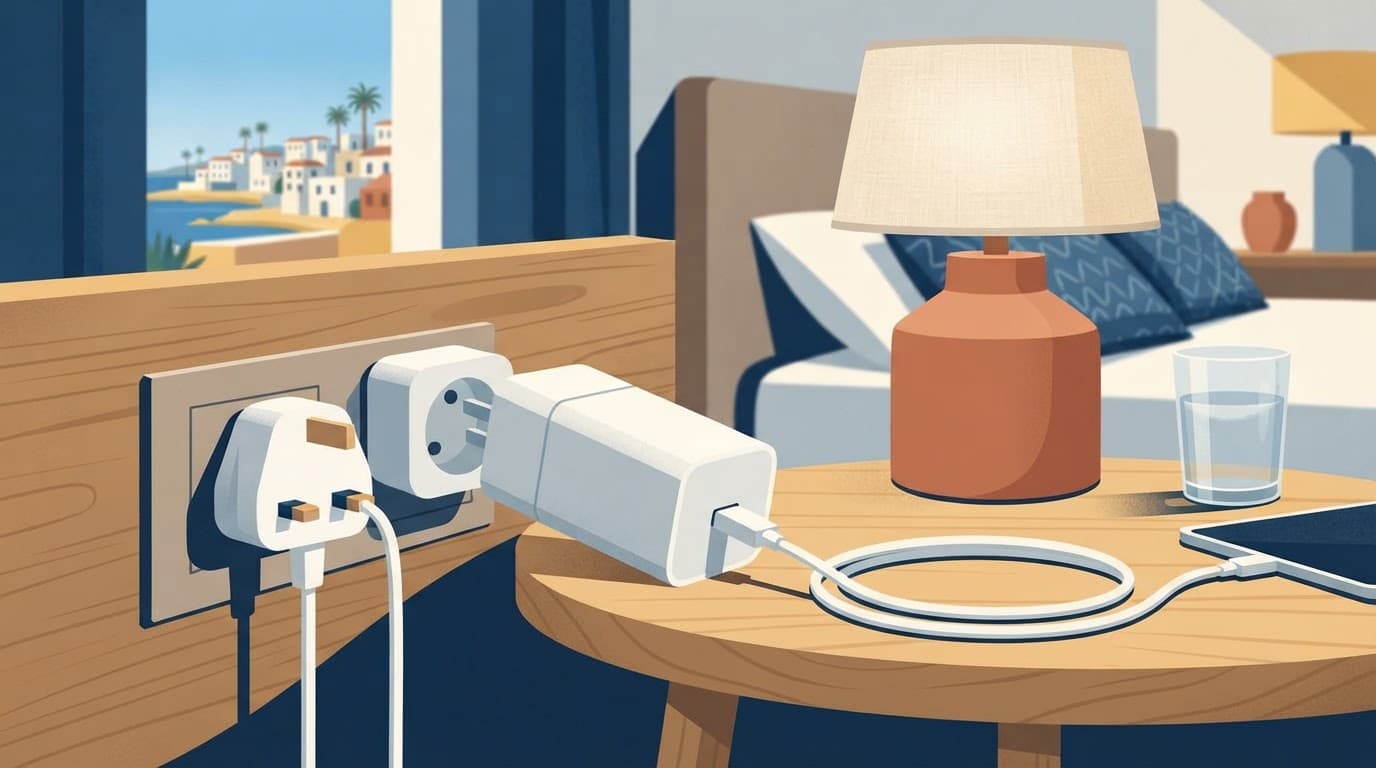
Recognising a Type G socket
Type G plugs have a top earth pin and two lower rectangular pins. Their larger shape can seem old-fashioned beside compact European plugs, yet they are convenient for UK travellers because the plug and socket match.
Many wall sockets have an on-off switch next to the plug holes. If a phone does not charge, we’d check the switch before blaming the cable. In older rooms, sockets may sit behind bedside furniture, so a short, flexible charging lead helps.
Cyprus Electricity: 230 V and 50 Hz
Cyprus runs on 230 V at 50 Hz. That matches the UK mains standard, so normal UK phones, laptops, cameras, e-readers and battery chargers work without a voltage converter.
Some country charts still show 240 V. In practical terms, UK equipment rated 220 to 240 V and 50 Hz is compatible. Cyprus is grouped with the UK and other countries using this plug format in wider country guides.
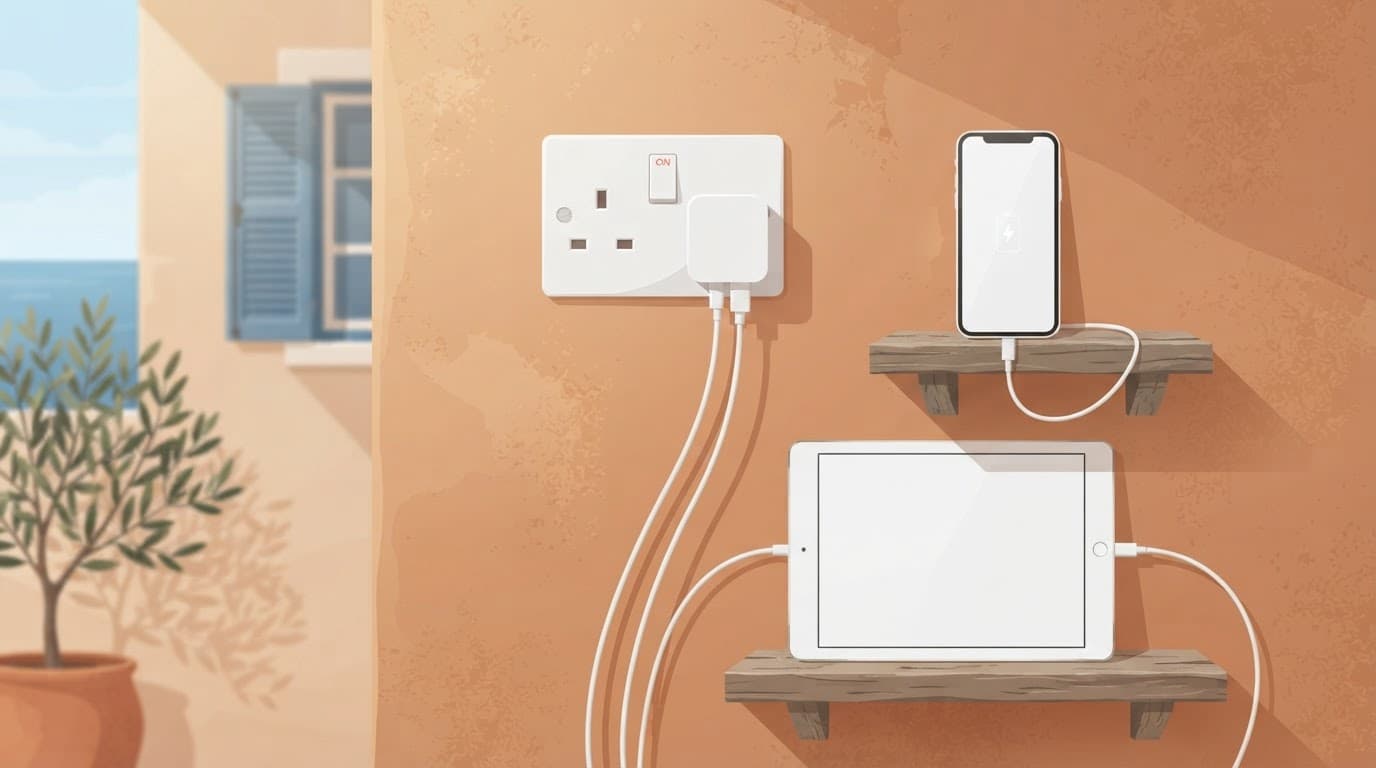
Read the input label before departure
Most USB charging blocks say “Input 100-240 V, 50/60 Hz”. They can handle Cyprus power and only need the correct plug, which UK versions already have. A device marked 110-120 V only needs a proper step-down voltage converter, not merely a plug adaptor.
A travel adaptor changes the plug shape. It cannot safely change 230 V electricity into 110 V power.
Hairdryers, curling tools, clothes steamers and electric shavers need extra attention because they use more power. We’d leave any 110 V-only heat appliance at home. It is usually lighter and safer to use the accommodation’s dryer.
When a Travel Adaptor Still Makes Sense
Our suitcase may contain a device bought abroad, even if we live in the UK. A camera charger with a European two-pin plug, an American laptop charger, or a borrowed travel gadget needs an adaptor that accepts its plug and ends in Type G. We’d check the voltage rating as well as the pin shape.
This quick guide covers common situations:
| What we brought | Do we need an adaptor? | What to check |
|---|---|---|
| UK phone or laptop charger | No | A standard UK Type G plug and an undamaged lead |
| European two-pin USB charger | Yes | An adaptor ending in Type G, plus its input rating |
| US charger marked 100-240 V | Yes | A Type G adaptor only |
| 110 V-only hairdryer | Yes, plus a converter | It is usually better left at home |
An adaptor should fit firmly and leave the socket switch reachable. We’d avoid loose, unbranded multi-plug towers, particularly beside a bed or on a hot balcony. If using a universal adaptor, one with a safety shutter is worth choosing, used only within its stated wattage limit.
UK extension leads are often handier
We usually pack one compact, fused UK extension lead when two of us are sharing a room. One wall socket can then charge several low-power devices without buying a pile of individual adaptors.
We’d pick a lead with a BS 1363 plug, and never connect one extension lead to another. High-wattage appliances stay separate, as a kettle, travel iron or heater can overload a cheap multiway lead.
Packing a Sensible Charging Kit
One dependable plug arrangement is better than five mystery adaptors at the bottom of a case. Our packing rule is to bring the leads we use every day, one small UK extension lead when sharing, and an adaptor only for foreign plug types.
We keep cables in a pouch so they don’t disappear under sun cream and swimwear. We also take a fully charged power bank for the flight and airport transfer. Airlines normally require power banks in hand luggage, so it’s worth checking the carrier’s current battery rules before travel.
Before leaving home, we’d test every charging brick, plug and lead. A failed cable is more annoying on a late arrival in Paphos or Protaras than a missing travel adaptor, because a replacement may not be close by.
When packing high-powered items, we’d give each its own space and avoid crushed cables. Damaged insulation, scorch marks or a loose plug are reasons to replace the item before travel.
Sockets in Hotels, Villas and on the Road
Most rooms have Type G wall sockets, although the number and position vary. A newer hotel may have USB ports beside the bed, while an older guesthouse could have a single socket tucked behind a cabinet. We’d charge a phone and power bank on arrival, rather than wait until bedtime.
Holiday lets often give more choice in the living area and kitchen than in bedrooms. We wouldn’t run an extension lead across a doorway or leave chargers beside a pool. Cyprus has long, dry summer days, but outdoor sockets, wet towels and bare feet are a poor mix.
A hired car can help on a beach day, yet its USB port may charge slowly. A good 12 V car charger works for a phone if necessary, though we’d avoid plugging a mains inverter into a rental car for hair tools or other heavy loads. The socket type does not change between coastal resorts, Nicosia and the mountains.
The Plug Detail We Can Cross Off
Our normal UK plug works with Cyprus sockets, so we can leave a country-specific adaptor off the shopping list. It’s worth confirming that any device bought abroad supports 230 V and 50 Hz, particularly if it produces heat.
We have found that one sound extension lead and a quick label check solve nearly every charging issue. With Cyprus plugs sorted, we can focus on the swimwear, walking shoes and plans that matter more.
Cyprus Plugs FAQs
Do UK plugs work in Cyprus?
Yes. Cyprus uses Type G outlets, the same three-pin system used in the UK. A standard UK plug fits directly, so British phones, laptops and chargers do not need an adaptor.
Should we pack a European travel adaptor?
No, not for a device with a UK plug. However, an appliance with a two-pin European plug needs an EU-to-Type G adaptor before it can connect to a Cyprus wall socket.
Can we use a UK hairdryer in Cyprus?
Usually, yes, if its rating says 220-240 V and 50 Hz. We’d check the label first, and avoid using damaged leads or overloaded extension sockets.