A Cyprus diving holiday can start with a calm first descent in a sheltered bay. It can also become an underwater adventure built around demanding wreck dives on the Zenobia. Conditions vary by coast, wind and season, so warm, calm water isn’t guaranteed year-round.
The east coast has many of the best dive sites, including beginner-friendly bays, the Zenobia wreck and MUSAN. Paphos offers a relaxed western base with shore and boat diving, while this guide covers PADI courses, seasonal planning and safety. I’d choose a resort around your planned sites when organising diving holidays, rather than crossing Cyprus between dives.
Why Cyprus works for new and experienced divers
The sea around Cyprus is usually calmest and warmest in summer, and its clear water can make orientation easier. Shore entries and guided shore dives avoid boat motion and can allow a controlled entry, reducing task-loading during a first dive.
At the same time, the island has enough depth, wrecks and training options to keep qualified divers interested. That contrast suits couples or families with mixed experience levels. Calm water doesn’t replace medical screening, respect for certification limits or honest self-assessment.
Gentle starts in sheltered bays
Green Bay Protaras is popular for first dives because its descent is gradual, although wind and entry conditions can change. A qualified instructor should assess the site and your comfort before teaching breathing, buoyancy and mask-clearing skills in the shallows. This makes it a useful setting for beginner scuba diving when conditions and confidence align.
Discover Scuba Diving sessions don’t require certification for the introductory session. Treat them as supervised tasters, not independently planned dives, with a briefing, shallow-water skills and an instructor-led dive. Check current training agency supervision requirements and equipment inclusions with a properly registered local operator, as packages vary between centres. Many centres provide a wetsuit, mask, fins, BCD, regulator, cylinder and weights.
More depth for qualified divers
Experienced divers can book boat dives, deeper reefs and the Zenobia wreck. Courses in advanced skills, nitrox and wreck procedures are also widely available.
Good conditions don’t remove the need for sound judgement. Your qualification, recent diving experience and confidence should determine the site, not the most dramatic photo on a booking page.
Scuba diving Cyprus: choosing the right base
Larnaca, Protaras, Ayia Napa and Paphos all work as dive bases, but they create very different holidays. The best dive sites for your trip depend on location, travel plans and the type of diving you prefer.
Protaras and Ayia Napa offer easy access to several well-known east-coast sites. A useful overview of Cyprus dive sites shows the close grouping of the Zenobia, Green Bay, MUSAN and Cape Greco. This can help you plan a varied week without changing hotels, but not every site runs from every base.
The resort may also differ from the actual meeting point for a dive. Check current access, boat departure points, protected-area rules and seasonal closures with current dive centres, Cyprus’s competent authorities and the relevant municipal or park authority.
Larnaca for the Zenobia wreck
Larnaca is the sensible choice if the Zenobia wreck is your main goal. Dive centres normally organise boat dives to the wreck.
Many packages include transport, lunch and equipment, but confirm the departure harbour and inclusions with the current operator.
It also works well for a short break because Larnaca Airport is close to the city. Stay nearby if you want early starts and minimal travel before a boat departure.
Protaras and Ayia Napa for reefs and sculpture dives
Protaras and Ayia Napa suit beginners, snorkellers and certified divers who prefer scenic shore dives. Green Bay, the Cape Greco area and MUSAN are all on this side of the island.
This area also has plenty of beaches, restaurants and family hotels. Therefore, it is often the easier option when diving is only part of your holiday.
Paphos for a slower west-coast stay
Paphos has local sites and training courses. It suits travellers who want to combine diving with archaeological attractions, harbour evenings and trips into western Cyprus.
Ask a Paphos diving centre about local site access and check the centre’s current schedule before booking.
Don’t treat a day trip from Paphos to the Zenobia as a convenient default. If the wreck is non-negotiable, plan at least part of your stay in Larnaca or the Ayia Napa and Protaras area.
Taking a first scuba dive in Cyprus
A beginner scuba diving session usually lasts half a day, although the exact schedule depends on the centre and site. You don’t need to have dived before, but you must be comfortable in water and complete the operator’s medical questionnaire honestly.
Tell the operator about asthma, heart conditions, medication, recent surgery, ear problems or pregnancy before paying. If the questionnaire requires medical clearance, arrange it with an appropriately qualified diving doctor before travelling. Check current screening and training requirements with the relevant training agency and a reputable operator, rather than relying on a generic online form.
What happens during Discover Scuba Diving
On arrival, allow time for registration, paperwork and any final health checks. The instructor should confirm the planned site, weather conditions and entry method before the session begins.
Before entering the water, the team checks and fits your dive equipment. The safety briefing covers hand signals, equalising, buoyancy, controlled ascents and emergency procedures.
You then practise a few core skills in shallow or confined water, with time to settle your breathing. The instructor should make sure you’re comfortable before moving further from shore or the boat.
Once ready, the guided dive stays within a conservative depth and duration. Your instructor remains close throughout, while you follow the agreed signals and pace. After surfacing, follow the operator’s advice about further diving, flying and other post-dive limits.
This Discover Scuba Diving session is a taster experience, not an open water certification. It doesn’t qualify you to dive independently.
Bring swimwear, a towel, sun protection and drinking water. A rash vest can be useful for boat rides, even in warm weather.
How to choose a beginner-friendly dive centre
Ask whether the advertised price includes all equipment, insurance, transfers, photos and marine park or boat fees. Also check the cancellation terms, particularly if weather or sea conditions could change the plan.
Choose a reputable PADI diving centre that explains its medical and training requirements clearly. If you’re staying on the west coast, compare a Paphos diving centre with other local options, as travel time and entry sites can affect the day.
We would also check group size, the instructor-to-guest ratio and the entry method. Ask whether the session suits your diving experience. A small group and a calm shore entry can make a first dive feel far less rushed.
A low headline price can exclude equipment or transfers, so compare the final total rather than the first number on a booking page.
PADI courses and next qualifications
Cyprus dive centres commonly offer PADI programmes, from Discover Scuba Diving tasters through to professional training. A local PADI diving centre may also teach another agency’s system, so check that your certification path matches your plans.
Discover Scuba Diving is a supervised taster, while PADI Scuba Diver is a shorter certification with depth and supervision limits. Open Water Diver is the usual holiday qualification for most divers. With an open water certification, you can dive with a buddy within agency and operator limits. After Open Water, advanced open water adds deeper dives, navigation and adventure dives, but doesn’t qualify you for complex wrecks.
A current Cyprus Open Water course commonly costs around EUR590 to EUR650, depending on e-learning, kit hire, transfers and certification fees. Referral courses cost less because you complete theory and confined-water training at home before travelling.
Nitrox and wreck training
An Enriched Air Nitrox course covers gas analysis, oxygen exposure and dive planning, not deeper diving. Nitrox can extend no-decompression time on suitable repetitive dives, but it doesn’t remove no-decompression, oxygen-exposure or depth limits. Analyse your own gas before every nitrox dive.
Wreck-speciality training is worth considering if you want to move beyond viewing a wreck externally. Technical diving may be needed for deeper penetration; this requires appropriate training, equipment, redundant lights and a specific route plan.
Diving the Zenobia wreck near Larnaca
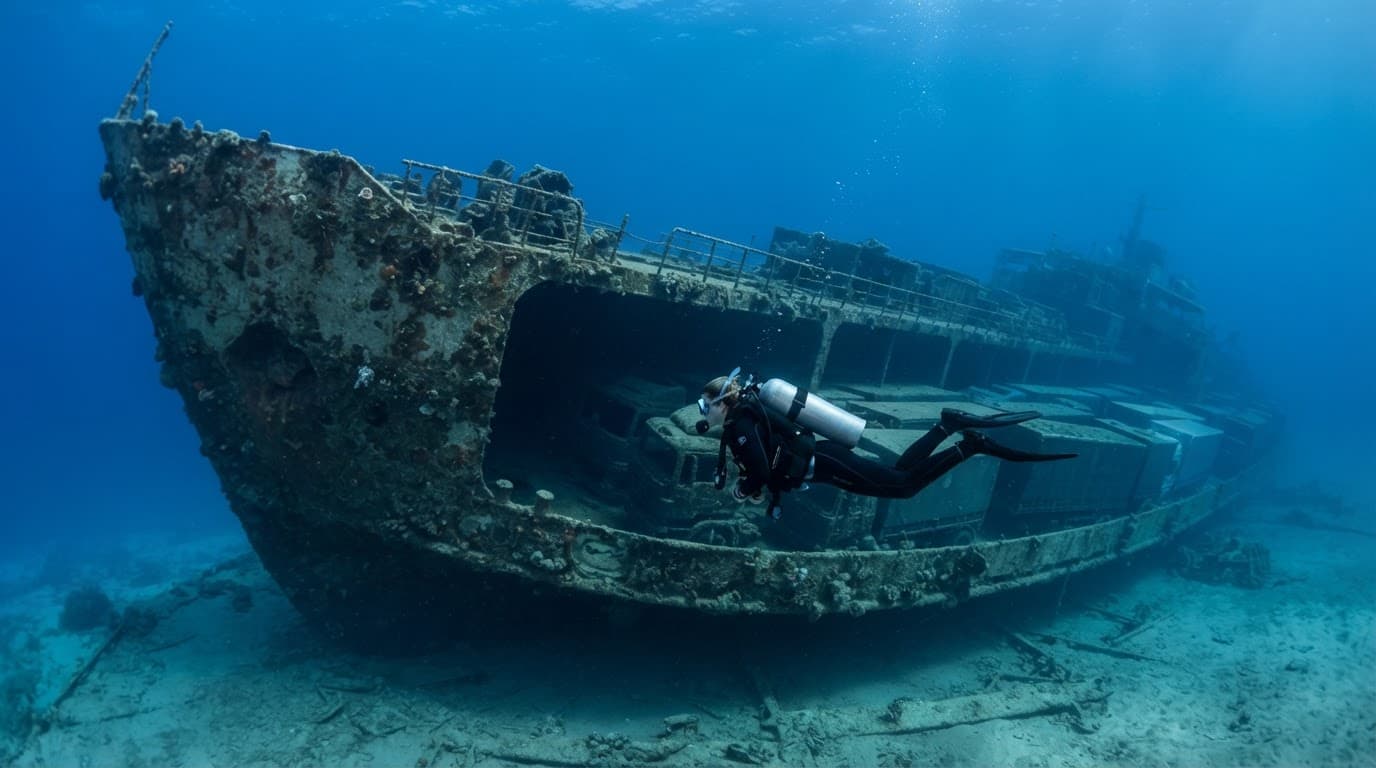
The Zenobia was a Swedish-built roll-on, roll-off ferry that sank off Larnaca on 7 June 1980, during her maiden voyage. The upper sections begin at roughly 17 to 18 metres, while the wreck reaches about 42 to 43 metres.
Today, the Zenobia wreck is a substantial underwater attraction and a challenging open-water dive. A normal Zenobia wreck dive usually stays outside the vessel. Depending on the route, divers may see lorries in the cargo areas, broad decks, long railings and fish life around the hull. These features aren’t guaranteed on every route or in every visibility. Divernet’s guide to the Zenobia and Cyprus reefs offers useful background on its international reputation.
Who should dive the Zenobia
The outer sections can suit capable recreational divers with the right certification, recent dive history, diving experience and comfort at depth. Yet this wreck dive site demands more planning than a shallow reef. Depth, currents, boat procedures and the ferry’s scale can overwhelm anyone who hasn’t dived for years.
Before booking, ask the centre which sections are planned, the maximum depth, gas, expected current and number of dives. Confirm current site and port requirements too, as access arrangements can change. Operators may ask inactive divers to complete a check dive before visiting the wreck.
Penetration is restricted to appropriately trained wreck divers with the correct configuration and a planned route. A guide’s presence doesn’t make an untrained penetration safe. Follow the agreed route, carry the equipment required for the plan and never enter an enclosed area on a casual holiday dive.
MUSAN, the underwater museum near Ayia Napa
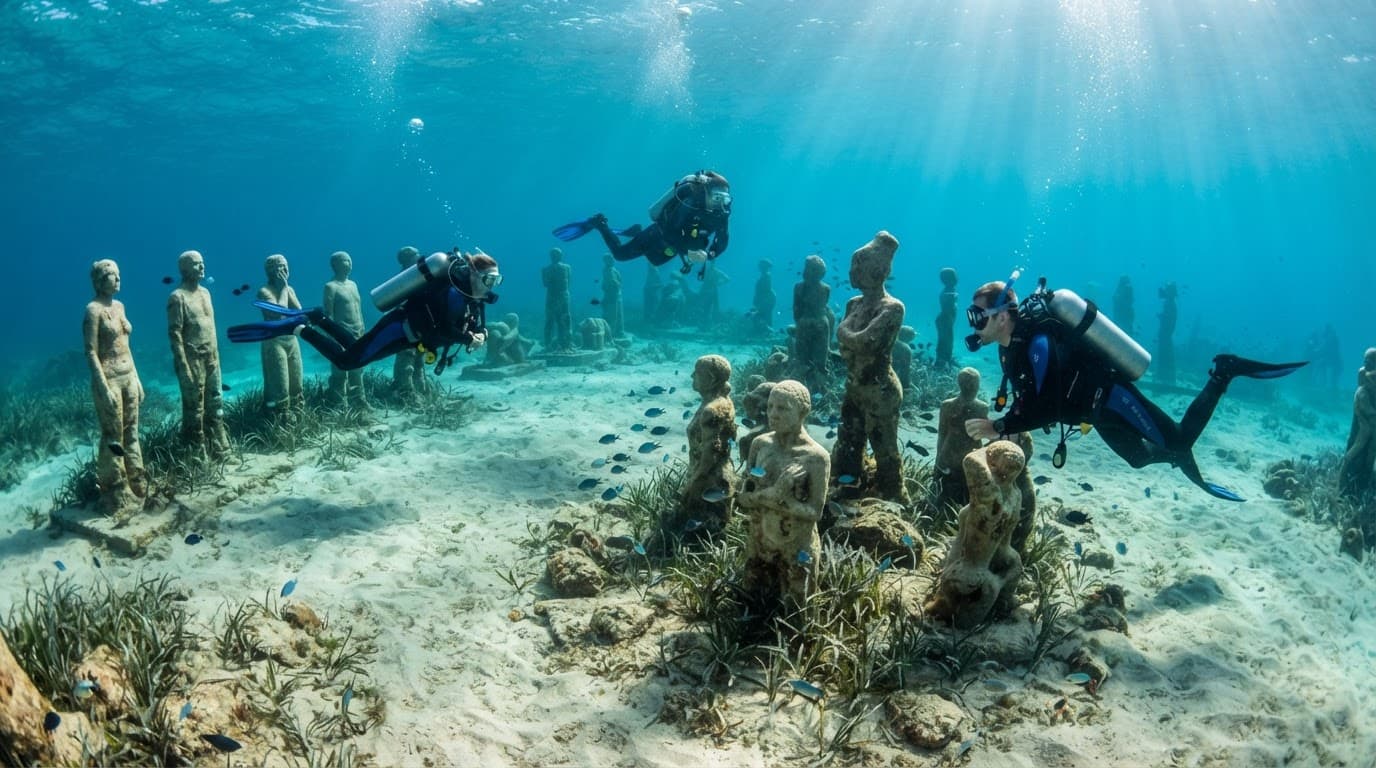
MUSAN, the Museum of Underwater Sculpture Ayia Napa, is an underwater museum on the seabed near Ayia Napa. It forms an underwater sculpture park, with human figures and planted structures arranged in relatively shallow water.
It offers a different kind of underwater adventure from a natural reef or wreck. The focus is on shapes, light and seagrass, rather than distance or depth. That can suit newer certified divers and confident first-timers on supervised trips.
A local MUSAN dive-site guide shows how the site is offered alongside other east-coast dives. Some centres may arrange snorkelling, which helps when non-divers travel with you.
Availability and access details vary by operator. Before booking, confirm the current access method, permitted entry points, depth, route and booking requirements. Also check opening dates, seasonal restrictions and any municipal or marine-protection rules.
Diving with care at MUSAN
Don’t touch, climb on or sit on the sculptures, and don’t disturb the seabed for a photo. Maintain good buoyancy, avoid seagrass and never kneel for photographs.
Keep a respectful distance and follow your guide’s route. The best photographs often come from staying still and letting the scene speak for itself.
Marine life and sea conditions around Cyprus
Cyprus is in the eastern Mediterranean, so its marine life differs from tropical destinations. There is no universal ranking: the best dive sites vary with habitat, weather and diver ability. Mediterranean diving here explores rocky reefs, seagrass beds and wrecks, which support small schooling fish rather than dense coral gardens.
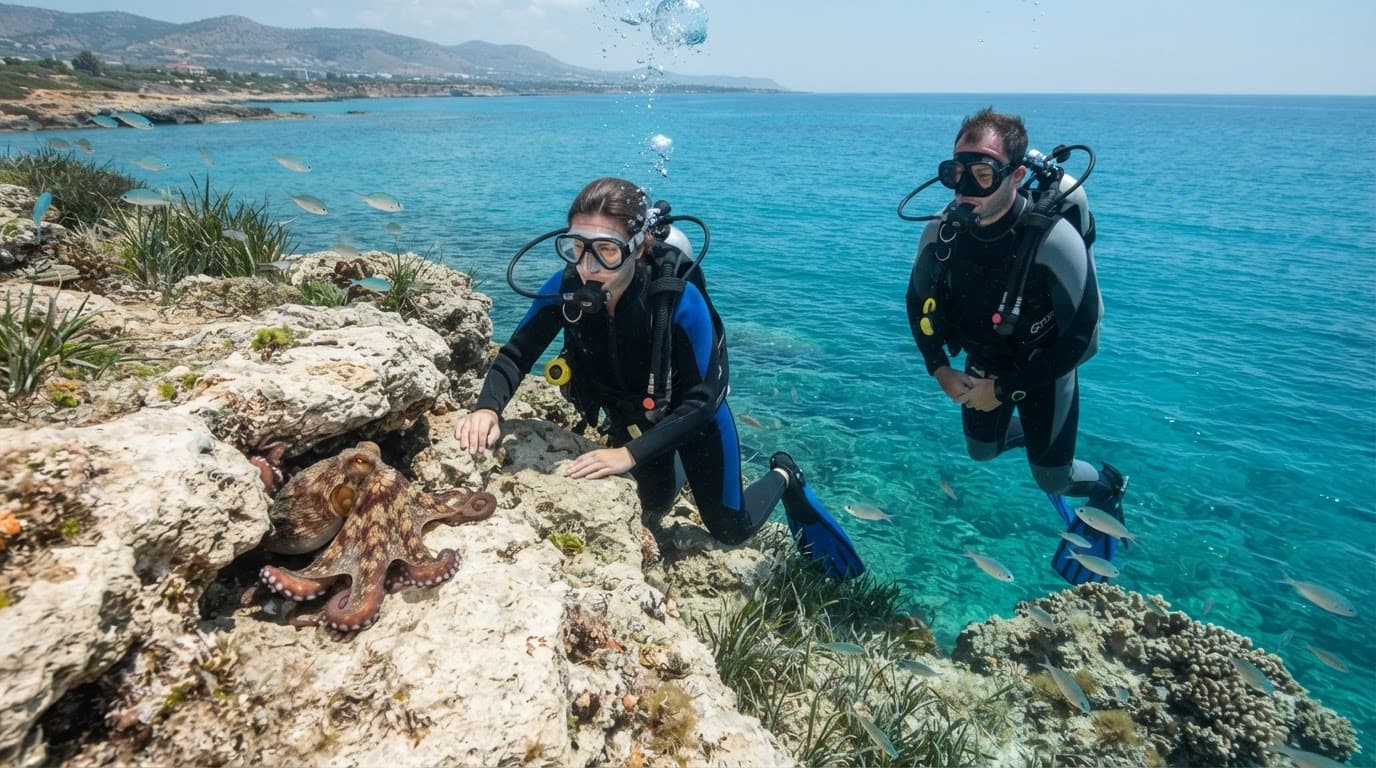
Around reefs and wrecks, divers often see groupers, barracuda, bream, damselfish, moray eels and octopus. Turtles can appear, particularly around seagrass areas, but no responsible operator can guarantee a turtle or other wildlife sighting. Follow current Cyprus fisheries, environmental and park rules around protected seagrass and reef areas.
When to plan your dives
For diving in Cyprus, the main season generally runs from spring into late autumn. Water can reach 27°C in summer and sit near 18°C in winter, while visibility ranges from 10 to 40 metres. Good summer days often bring 20 to 35 metres, but these figures are planning ranges, not guarantees.
July and August bring the warmest sea and busiest boat traffic. Offshore wind can disrupt boat dives. May, June, September and October can offer a better balance of pleasant water, lighter crowds and comfortable surface temperatures.
Winter diving is possible with thicker exposure protection, but weather can cancel trips. Build flexibility into any short break outside the main season.
What scuba diving in Cyprus costs in 2026
Prices vary by resort, season, group size and exchange-rate conditions. The ranges below are indicative planning figures from multiple published Cyprus operator rate cards checked for the 2026 season. They aren’t fixed island-wide prices, averages or guarantees.
| Activity | Typical 2026 price | Inclusions to verify |
|---|---|---|
| Discover Scuba Diving | EUR70 to EUR180 | VAT, briefing, kit, transfers, photos and insurance |
| One local certified dive | EUR45 to EUR70 | VAT, cylinders and weights, guide, shore or boat fees, transfers and insurance |
| MUSAN dive or taster | EUR50 to EUR180 | VAT, certification where required, kit, transport, photos, boat and marine-park charges |
| Zenobia two-dive day trip | EUR130 to EUR225 | VAT, boat fees, kit, lunch, transfers, photos and marine-park charges |
| Open Water Diver course | EUR590 to EUR650 | VAT, certification, e-learning, kit, transfers, photos and insurance |
The final column lists items to verify, not inclusions guaranteed by every operator. A simple beginner shore experience is usually the least expensive route. MUSAN combinations and Zenobia trips cost more because they may include a boat, transfer, extra staff or two dives.
Some operators include a full set of dive equipment, while others provide only cylinders and weights for certified divers. Confirm whether VAT, certification, transfers, photos, lunch, marine-park charges, boat fees and insurance are included or charged separately.
Ask for the complete payable total and cancellation policy before booking. Check the cost of a computer, nitrox, transfers or required marine-park fees if they aren’t included. Nitrox may be free for certified users, but don’t assume it’s included.
Planning transport, safety and insurance
If diving is your priority, stay on the east coast to reduce transfer time. Larnaca suits early Zenobia departures, while Protaras and Ayia Napa keep you close to Green Bay, Cape Greco and MUSAN.
Without a hire car, choose a centre with a published hotel pickup window, or stay near its meeting point. If you drive, confirm hire-car parking and allow time for checks before departure. Public transport can suit resort sightseeing, but fixed boat times leave little margin for delays, so don’t rely on a late bus.
West-coast visitors should ask a Paphos diving centre to confirm local pickup, available sites and transfer costs before booking.
Booking a responsible operator
Choose a registered operator, including a PADI diving centre, with insured instructors, serviced rental kit and clear emergency procedures. Check recent reviews for practical details, such as punctual transfers and groups matching the promised experience level.
Check that professional dive instructors hold suitable qualifications, provide active supervision and give clear site briefings. Cancellation terms should also be clear before you pay.
Before relying on compliance claims, check current Cyprus registration, port or marine-park requirements, site-access rules and operator standards with the relevant Cyprus authority and your dive centre.
Travel insurance for diving in Cyprus must cover your planned depth and activities, including boat or wreck trips. Standard policies may exclude deeper dives or activities without a qualified guide, so read the wording carefully.
Avoid flying after diving until you’ve followed guidance from your dive computer, training agency and reputable diving-medicine sources. No-flight recommendations depend on your actual dive profile, so don’t rely on one universal interval. Leave your final full day free of diving before a flight home as a conservative precaution.
Protecting the underwater sites
Good diving leaves little evidence behind. Don’t touch marine life or the seabed, feed fish, collect shells or wreck objects, or deliberately contact turtles.
Keep fins clear of seagrass and reef, avoid anchoring on sensitive habitat and take all litter with you. These actions help prevent damage at popular sites.
Bring a refillable bottle and avoid disposable items at each marina stop. Small choices matter when busy summer boats visit the same sites every day.
Common questions about diving in Cyprus
Do you need experience to scuba dive in Cyprus?
No, not usually. Discover Scuba Diving programmes are designed for beginners and include close instructor supervision. You’ll still need to complete the operator’s health questionnaire and meet its water-comfort requirements.
Is the Zenobia suitable for newly certified divers?
Not automatically. Some outer sections may suit newly certified divers with the right qualification, diving experience and recent practice. Your dive centre will also consider sea conditions and your comfort before confirming the plan.
What equipment is usually included?
It depends on the operator and package. Beginner programmes often include core scuba equipment, while certified-diver trips may charge separately for hire. Confirm whether the price covers a wetsuit, BCD, regulator, computer, tanks and weights.
Can non-divers join a dive day?
Sometimes, but not every boat or operator accepts non-divers. Options may include a boat trip, snorkelling or a beach-based visit, with spaces and prices varying. MUSAN is one of the easier east-coast choices for mixed groups.
Continue Planning Your Cyprus Holiday
- Zenobia Wreck Diving Guide
- Best Beaches in Protaras Guide
- A Weekend Guide to Larnaca
- Cape Greco National Forest Park Visitor Guide
- Paphos Activities Beyond the Harbour
Final Thoughts
The best days underwater come when you match the site to your certification, recent activity, conditions and confidence. Your diving experience should guide the plan, not the most dramatic booking image. Start in a sheltered bay if you are new, then work towards deeper wrecks or further training as your skills develop.
For many UK travellers, Protaras and Ayia Napa offer a convenient east-coast base for diving, beaches and straightforward transfers, though another area may suit your plans better. Scuba diving Cyprus is most enjoyable when you leave room for changing weather, a non-diving day and time above the water. Listen to the briefing, choose conservatively and enjoy the experience.