Cyprus can feel dry and hot by the coast, then turn cool and green in the mountains. The island’s best falls are mostly around Pano Platres and the Paphos area, where pine forest, streams and village roads replace the usual beach-day scenery.
Spring usually brings the fullest streams, while some falls shrink after a dry summer. A waterfall may involve a proper walk, a steep scramble or little more than a roadside stop. Check access before setting out, and don’t assume every pool is suitable for swimming.
Cyprus waterfalls at a glance
Most choices sit in the Troodos mountains, so you don’t need to chase every waterfall on the island. Pick one that suits your walking confidence, your hire car and the season, then leave time to enjoy the nearby villages.
| Waterfall | Best for | Access reality |
|---|---|---|
| Caledonia | A proper shaded pine forest walk | Uneven riverside trail with slippery sections |
| Millomeris | A short Troodos stop | Village walk or narrow approach road |
| Chantara | A quiet Foini detour | Short viewing stop after a dirt-road drive |
| Mesa Potamos | A low-effort scenic pause | Brief path from limited parking |
| Kremiotis | A compact Paphos hike | Moderate loop with a little ascent |
| Adonis Baths | Swimming in a managed site | Paid entry and a rough final approach |
Caledonia is the best choice if you want walking to be part of the experience. Millomeris suits travellers who want a waterfall without committing to a long hike.
Meanwhile, Chantara and the low-effort option work well as short stops between mountain villages. We’d treat Adonis Baths as a separate attraction, rather than a free natural walk.
Choose spring for the strongest water flow
Water changes every waterfall visit. A cascade that runs with force in April can shrink to a narrow trickle after a long, dry summer.
March to May brings the best chance of full falls
Late March, April and May are usually the most rewarding months for waterfall walks. The spring season brings winter rain and mountain snowmelt, while daytime temperatures remain comfortable for walking uphill on hiking trails.
The seasonal pattern also matches the advice in Troodos waterfall route guides, which favour late spring and early summer. After rain, take extra care because stones and roots become slick.
Summer visits need different expectations
June to September can still be pleasant in the forest, especially early in the morning among the pine forest. Yet water flow often drops sharply, so go for the scenery and cooler air rather than expecting a roaring cascade.
Winter can bring more water, but ice, snow and mud may affect high Troodos paths. Check Department of Forests trail information before a mountain walk, particularly after storms.
A waterfall is usually at its most photogenic after wet weather, but the trail is often at its least forgiving on the same day.
Caledonia Waterfalls for a classic forest walk
Caledonia Waterfalls is one of the best-known waterfall walks in Cyprus, following the Kryos Potamos, or Cold River, through pine forest above a mountain village. Scottish visitors are said to have given the waterfall its name after their homeland.
Follow the Caledonia Waterfalls trail from Psilo Dendro
For the full outing, begin near Psilo Dendro above Pano Platres and follow the nature trail beside the river. The longer route is commonly described as roughly 3 km one way, although shorter access walks create lower distance estimates online.
We would allow two to three hours for a relaxed return walk with photo stops. The route has packed earth, stones, steps and damp patches, so it is more demanding than a flat promenade. It isn’t suitable for pushchairs, and small children need close supervision near the river.
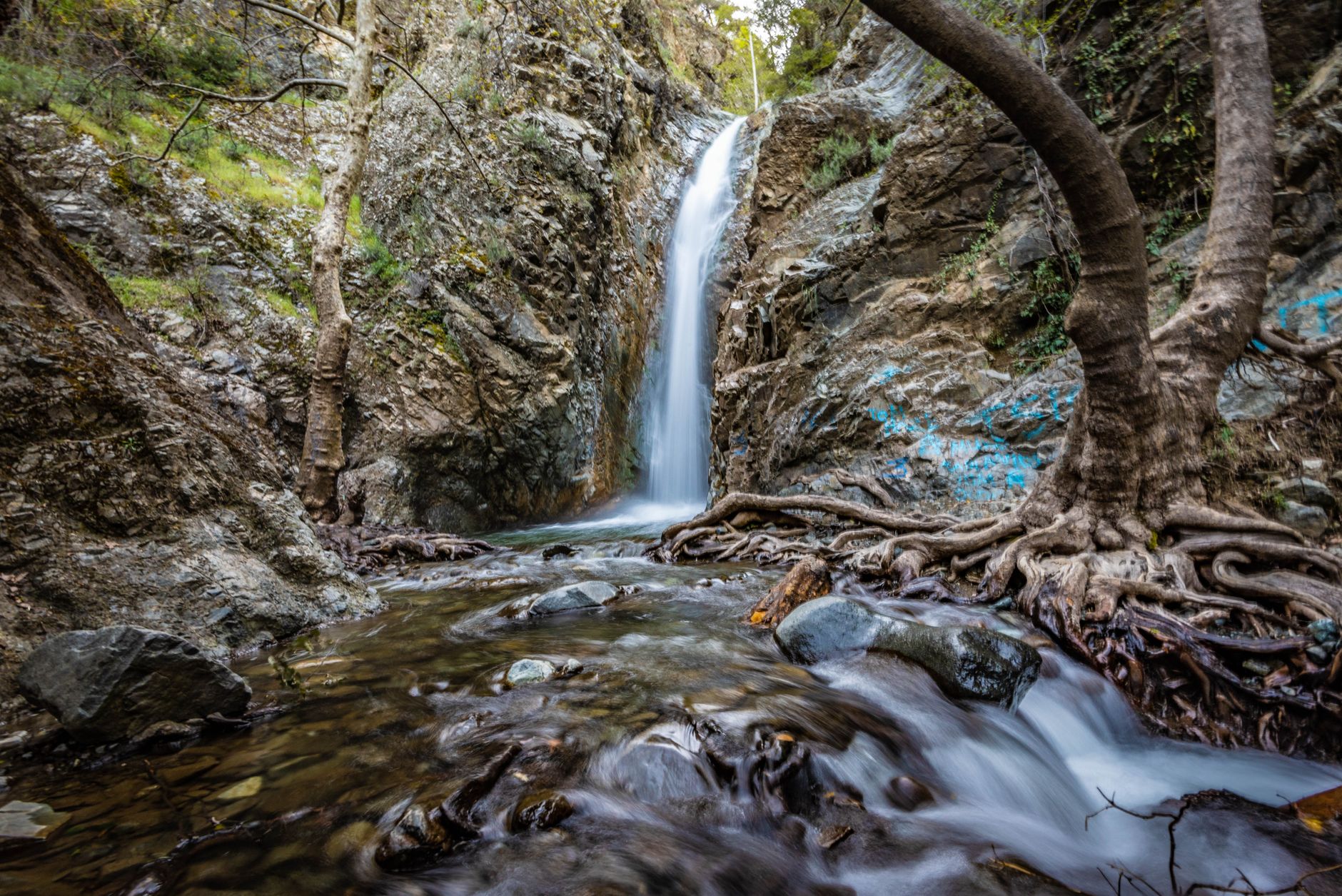
Photo by KLEANTHIS SOTIRIOU
Plan for limited parking and wet ground
Entry to the nature trail is free. Informal parking near Psilo Dendro can fill up in warmer months, so an early start makes the walk calmer.
Wear trainers or walking shoes with proper grip, rather than sandals. We wouldn’t plan to swim at Caledonia, as there is no confirmed managed swimming area at the falls. The reward here is the woodland walk, the sound of the river and the shaded approach.
Millomeris Waterfall from Pano Platres
Millomeris Waterfall is the quickest major waterfall stop near Pano Platres. It is often described as the highest waterfall in the Troodos range, and the regional Troodos waterfalls guide gives its drop as 20 metres.
Walk down from the village
To reach the waterfall on foot from the village, start near Panayia Faneromeni Church and follow the signed path downhill. The route is around 1.2 km one way and usually takes 30 to 45 minutes, depending on your pace.
The descent passes through pine forest and feels straightforward, while the walking distance remains manageable. However, the climb back up is steep enough to raise your heart rate. This is a good choice for active families and anyone who wants a proper walk without spending half a day on the trail.
Use the closer road approach carefully
You can drive closer to the waterfall, then take a short descent from a nearby pull-in. However, the roads around the falls are narrow, winding and awkward for larger hire cars.
We prefer the village walk when the weather is mild. It removes the stress of negotiating tight bends and makes the waterfall feel like a destination rather than a quick roadside stop. There is no entrance fee, but don’t assume the stream or pool is a designated bathing area. Follow local signage and current conditions before entering the water.
Chantara Waterfall near Foini
Chantara Waterfall, also written as Hantara, is a quieter Troodos stop near Foini. The waterfall is about 1.5 km north of the village and drops around 8 metres into a small pool.
Take the Foini approach, not a blind GPS shortcut
From Foini, the approach is about 0.3 km on asphalt followed by roughly 1.2 km on a dirt track. It is a short stop once you arrive, but the drive may not suit every vehicle.
Set Foini as your first waypoint, then follow local signs towards the waterfall. The route from Trooditissa Monastery is longer and includes an unpaved section.
Chantara has a peaceful pine forest setting, with a natural pool below the cascade. Although the pool looks inviting, we would not assume it is safe or permitted for swimming. There is no confirmed managed bathing area, lifeguard cover or formal water-quality information.
Mesa Potamos for an easy mountain stop
Mesa Potamos is a sensible choice when you want a waterfall without a long hike. Troodos Geopark lists it at about 7 metres high, in the Arkolachania river valley near Timios Prodromos Monastery, among pine forest.
Pair the falls with a picnic or monastery visit
The waterfall lies around 5.5 km north-west of Moniatis and is reachable by car. A short path leads from the nearby parking area, although spaces are limited.
Recent Mesa Potamos visitor reports also describe a brief, easy approach. That makes it useful for travellers with limited walking time or children tired of steep trails. Low effort doesn’t mean step-free access.
The site works best as part of a wider Troodos drive. Bring a picnic, or pair the stop with a nearby picnic site and monastery visit. Ground can still be uneven, especially after rain, and the pool isn’t a confirmed swimming location.
Kremiotis Waterfall near Kritou Terra
Kremiotis Waterfall sits north-east of Kritou Terra, in the Paphos region. It feels more secluded than the well-known falls around Platres and makes a good change from the coast.
Expect a short but proper loop walk
The Kremiotis Waterfall Loop is listed at 1.9 km, with around 89 metres of ascent. Most walkers complete it in 30 to 60 minutes, although wet ground or photo stops can add time.
The grotto adds to the appeal, alongside the waterfall and enclosed valley scenery. Wet ground and the grotto make proper footwear worthwhile, while the compact loop still needs basic confidence on uneven paths.
The waterfall is a better pick for walkers than for anyone seeking a dip. Visitor information describes small pools nearby, but not a dependable place for swimming. We’d keep the plan simple, walk the loop, enjoy the shade and head back to Kritou Terra for a village break.
Adonis Baths: swimming, fees and road warnings
Adonis Baths is near Kili Village in the Paphos region. Unlike free waterfalls elsewhere, this private visitor attraction draws on Greek mythology, with a watermill and managed swimming pools.
Treat it as a paid attraction
At the time of checking in August 2026, the Adonis Baths official website lists an entrance fee of EUR15 for adults and EUR10 for children. Prices can change, so check again before setting off.
Visitors can swim in the baths, and swimming is a major reason people go. However, expect cold water, even during a hot Cyprus afternoon. Bring swimwear, a towel and shoes that can cope with wet ground around the pools.
Do not trust every sat-nav turn
The final approach includes a rocky road and a partly unpaved dirt track leading towards the parking area. Google Maps can send drivers towards unsuitable routes, so this trip needs more care than its distance suggests.
Follow signed directions from Tala or Coral Bay where possible. If your navigation sends you down a narrow, rocky lane that doesn’t feel right for a low-clearance rental car, turn back safely rather than pressing on.
We’d avoid making Adonis Baths your first drive on rough roads in a low-clearance vehicle. It can be fun, but the access is part of the outing and deserves more thought than the short distance suggests.
Drive, walk and swim with a realistic margin
A little preparation avoids the most common frustrations. Cyprus mountain roads can be slow, and waterfall paths rarely have the smooth surface suggested by a location pin.
Pack for the path, not the beach
Take a light day bag even if you only plan a short walk. Our basic kit includes:
- Grippy trainers or walking shoes, because smooth soles struggle on wet stone and uneven hiking trails.
- At least 1.5 litres of water per adult for a half-day mountain outing.
- A light layer, as shade in the pine forest and higher altitude can feel cooler.
- Offline maps and a charged phone, since directions can become confusing on minor roads.
Avoid flip-flops on the steeper walks and longer routes. They are fine for a poolside afternoon, but not for roots, loose stone and steep descents.
Match the outing to your group
The lowest-commitment option has the least walking, while the village-based route offers an easy start. Longer river trails suit fit walkers who want more time on foot.
Children can enjoy these walks with close supervision, yet none of the natural trails should be treated as step-free. The rougher routes are unsuitable for pushchairs, while another asks you to be comfortable with a dirt-road approach.
Read your rental car agreement before driving on unpaved roads. Some providers restrict them, and a scenic detour is not worth a dispute over vehicle damage. Keep natural pools for looking unless swimming is clearly allowed and conditions feel safe.
Build a waterfall day without rushing
A good waterfall day usually centres on one main walk, rather than a crowded list of pins. Mountain driving takes longer than expected, especially around Platres and Foini, so leave room for delays.
Base a Troodos day around Pano Platres
Start with your chosen waterfall if you want a manageable morning walk. Then have lunch in Pano Platres and decide whether you have the energy for a second stop.
If one walk is your main aim, go there first and give it the time it deserves. Combining two walks can work for confident walkers, but it is too much for many families in summer heat.
Keep rough-road stops flexible
Mesa Potamos pairs neatly with a drive through Moniatis and the monastery area. Chantara Waterfall can follow if you’re happy with unpaved access and conditions are dry, but rain may make the route slower.
For Paphos, choose the waterfall near Kritou Terra as your main walking stop, then explore the villages around Polis and Kritou Terra. Keep Adonis Baths for a separate half-day, particularly if you’re travelling with young children or feel unsure about the approach road.
Frequently Asked Questions
Which waterfalls are easiest to visit in Cyprus?
Millomeris, Mesa Potamos and Chantara work well for shorter outings, although Chantara involves a dirt-road approach. Caledonia is a better choice if you want a proper shaded forest walk rather than a brief stop.
When is the best time to see Cyprus waterfalls?
Visit between late March and May for the strongest chance of full water flow and comfortable walking temperatures. Falls can shrink considerably after a dry summer, while winter rain may make paths muddy, slippery or affected by snow.
Can you swim at Cyprus waterfalls?
Some natural pools look inviting, but they are not automatically safe, permitted or managed for swimming. Adonis Baths is the clearest swimming option because it is a paid attraction with managed pools, although the water can be very cold.
Do I need a 4×4 to visit the waterfalls?
You can reach the main Troodos waterfalls with a normal hire car, but some minor roads are narrow, winding or unpaved. Chantara and Adonis Baths need particular care, so check your rental agreement and turn back if the road becomes unsuitable for your vehicle.
Final thoughts on waterfall walks in Cyprus
The best Cyprus waterfalls are not all reached in the same way. Caledonia rewards a proper forest walk, while Millomeris offers an easier classic outing. The shortest option suits days when time is limited.
Spring usually brings the best conditions, but sound footwear and sensible driving still matter. Choose one site that fits your group and the day, rather than chasing every map pin.